|
Regional Heritage Centre Newsletter, October 2024
In this edition:
- Book now for the RHC's November event Elections in Lancashire 1783 - 1928
- A look at our new programme card with some highlights of the 2024 - 2025 event season
- A sneak preview of the RHC's forthcoming new publication A Voice for the Landscape by Jeremy Rowan Robinson
- To celebrate Black History Month, RHC Director Chris Donaldson sifts the records for a tantalising glimpse of Edmund Andre, an early Black resident of the North West
- New history and heritage book - Roots and Branches - A Botanical Exploration of the Lake District 1775 - 1900 by Ian Hodkinson
Book Now for the RHC's November Event on Elections in Lancashire
Things are heating up for our November event, Elections in Lancashire 1783-1928, so why not join theregister and reserve your place today.On Saturday 9 November, we present a strictly non-partisan study day examining elections, electioneering and political representation in Lancashire from the late eighteenth to the early twentieth century. From the hustings of Georgian Lancaster to campaigns for female suffrage, this event will consider voters and voting, the elected and the excluded.
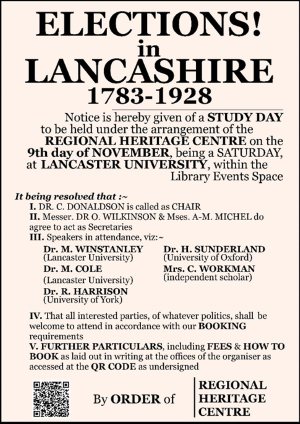
Participants include Dr Michael Winstanley (Lancaster University), Dr Matthew Cole (Lancaster University), Dr Richard Harrison (University of York & formerly Research Fellow, History of Parliament Trust), Dr Helen Sunderland (University of Oxford) and Christine Workman (independent scholar). Over the course of the day, you will learn about elections in Lancaster in the late eighteenth century; reforms to the franchise in Lancashire during the nineteenth century; the changing fortunes of political parties in the county; young voters and mock elections; and the specific role played by regional suffragists and suffragettes in gaining votes for women. Please note this event will be for in-person attendance only and will not be recorded.
All political persuasions are welcome, so come and join us. Tickets are on sale through our Online Store here.
We can promise you a fascinating event - but that's not all. Keep reading for a preview of some of our other highlights...
New Season Highlights - Hot Off the Press

Our new programme card gives the full line-up of RHC study days and events for the new season ... and we've given it a new look as well to make it easy to see at a glance just how much is on offer. But if you can't wait to get your hands on a copy, we're more than happy to give you a sneak preview.
We've already mentioned our exciting November event, but 2025 has much, much more in store.
For example, on Saturday 08 February 2025, Dr Alan Crosby will be back, delivering another of his incredibly popular one-man study days in his own inimitable style. This time, Alan will be looking at the history of social, political and religious movements and popular dissent and protest in the North West. From the Pilgrimage of Grace to the 1850s, we can't wait to hear what historical nuggets he's unearthed for us.
And speaking of unearthing treasures, on Saturday 1 March, it's the 52nd Annual Archaeology Forum. We'll be looking at the last phase of excavations at Birdoswald, the Roman fort on Hadrian's Wall and the re-excavations at the site known as King Arthur's Round Table. We'll also be taking a timely look at the contributions of women to archaeology in the North West. We hope you'll join us, whether it is in-person or online, for a roundup of all the year's most important developments. Don't miss it!
We're also looking to offer another of our popular excursions with Professor Fiona Edmonds in April, this time to Richmond Castle. Full details of that exciting opportunity will be available soon, so watch this space.
With so much to look forward to, we know you'll want to save the dates in your diary and keep an eye on our website for ticket sales notifications.
Of course, if you sign up as a Friend or Patron of the RHC, you'll be eligible for a full year of discounts on our events and publications, as well as special invitations and offers – like exclusive access to online lectures, etc.
And if you're already an up-to-date supporter yourself, why not spare a thought for the heritage fans in your life? You can also gift a subscription - check the details on the RHC website .
Coming Soon: A New Publication from the RHC and the Friends of the Lake District
The Regional Heritage Centre is looking forward to the imminent publication of our latest book, A Voice for the Landscape: Friends of the Lake District 1951-2001 by Jeremy Rowan Robinson.
The new volume will act as a kind of sequel or companion volume to our 2009 book Friends of The Lake District: the Early Years, taking the story forwards and looking at the establishment of the Lake District National Park in 1951 from the Friends' perspective, as they attempt to assess and combat any threats posed by development and tourism to one of England's most beautiful landscapes.
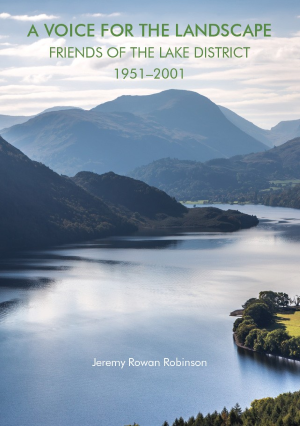
Front cover of A Voice for the Landscape
We expect to have A Voice for the Landscape available through our Online Store in November for £15...and we also plan to celebrate its release by offering both A Voice for the Landscape and Friends of the Lake District: The Early Years for a limited time only at the special price of £20. We can't wait for the big day, so watch our website for a newsflash if you want to be one of the first to order a copy!
Another Historical Tidbit from Dr Chris Donaldson
As our faithful newsletter readers know, the RHC is devoted to celebrating the history and heritage of the North West - and that history is most definitely multicultural. As we mark Black History Month in October, our Director, Dr Chris Donaldson, tells us about the difficulties of seeing the full picture.
Raking through early modern administrative records can be a tantalising experience. Sometimes they reveal evidence that enriches our understanding of local and regional histories. Consider the example of Edmund Andre, who was baptized at St Columba's Church, in Warcop, in October 1666.
Andre stands out to me especially this month because he's one of the earlier known Black residents of the rural North West. The presence of people of African ancestry in our region can be traced back into antiquity. It isn't until the 1600s, however, when England's global expansion entered a new phase, that the presence of Black people becomes more apparent in our region's parochial records. The documentation of a Black man named Peter and his son Richard in the Lancaster Priory register in 1602 is a notable example.1
Evidence of a Black or mixed-race family in Lancaster in this period, though it may surprise, shouldn't be regarded as exceptional. Recent research has greatly increased our understanding of the historical presence of people of colour in early modern English ports. The lives of Black people in England's rural interior, however, has been the subject of more sporadic study.2
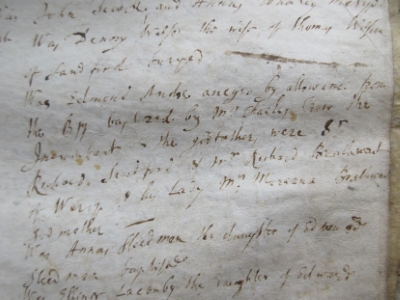
Excerpt from Warcop parish register, WPR 13/1, courtesy of Cumbria Archive Centre, Kendal
That makes evidence like the record of Andre's baptism a focus for further investigation, and we're fortunate that his baptismal entry is so detailed. In full, it reads:
'Edmond Andre a negro by allowanc from the B[isho]pp baptized by Mr Charles Crow the incumbant [sic] & the Godfathers were Sr Richard Sandford & Mr Richard Brathwait of Warcop & his Lady Mrs Mariana Brathwait Godmother.'3
There's more information here than appears in most contemporaneous entries in the church register. That might reflect Andre's social status. The use of the word 'negro' may be particularly significant. It's worth stressing, though, that the word's meaning in this context is a bit ambiguous. During the early modern era, it was used unsystematically to refer to skin colour and race.4
Anglican church registers were used during this period to determine parochial responsibility for the relief of people in need. Consequently, some historians have reasoned that clerks may have chosen to record a person's 'details of origin' (in this case by referring to a distinguishing characteristic) to signal that the individual in question didn't have the right of settlement in that parish at the time an entry was made.5
As Kathleen Chater writes, 'Conscientious clerks seem to have ensured that anything which could be used as evidence should there later be any dispute about a person's settlement status was included in the entries, primarily because of the financial implications for the parish.'6
So it's plausible that Andre's baptismal record indicates that, although he'd received the sacrament in Warcop, the parish wasn't responsible for his relief. If that interpretation is correct, then it might also explain why the clerk recorded the names of Andre's godparents. That sort of detail is absent from other entries in the register, and it might imply that Sandford's and the Braithwaites' responsibility for Andre extended beyond spiritual concerns. It wasn't uncommon in the 1600s for people of standing to serve as godparents for poorer members of their community. Nor was it uncommon for masters to stand as godparents for their servants.7
Still, the nature of Andre's relationship with Sandford and the Braithwaites is unclear. They were certainly people of standing in their locality, but we don't know whether Andre was a servant in one of their households. In the absence of further evidence, we should be wary of giving way to conjecture. Still, Andre's baptismal record would seem to imply a relationship of dependency between him and Sandford and the Braithwaites. Hopefully, further research will bring more clues to light.
Notes
1 Register of baptisms, marriages and burials, St. Mary, Lancaster, 1599–1691, PR 3262.1.1, Lancashire Archives.
2 There are important exceptions to be certain, however, including research recently published by Melinda Elder and Alan Rice. See, indicatively, Elder's article 'John Hannibal: “An African” of Overton in the Age of British Transatlantic Slavery, Contrebis, 41 (2023), 12–17.
3 Baptisms, marriages and burials, St Columba, Warcop, 1597–1744, WPR 13/1, Kendal Archive Centre.
4 See Onyeka, 'What's in a Name', History Today, October 2012, 34–39.
5 Kathleen Chater, Untold Histories: Black People in England and Wales during the Period of the Transatlantic Slave Trade, c. 1660–1807 (Manchester, 2011), p. 139.
6 Ibid.
7 Will Coster, Baptism and Spiritual Kinship in Early Modern England (Taylor and Francis, 2017).
Thanks Chris, for another illuminating insight into the history of the North West as we celebrate Black History Month.
Books and Publications
The RHC is always pleased to bring our supporters' attention to interesting publications on local history and heritage... and this month we have another book about the Lake District for you - but this one focusses on the natural environment of the Lakes in the 18th and 19th century.
Roots and Branches is about the people who gathered early information on the presence and distribution of the plant species that comprise the abundant flora of Lakeland.

Front cover of Front cover of Roots and Branches by Ian Hodkinson
Clergymen, doctors, businessmen, mountain guides, farmers, landed gentlemen and professional botanists all played their part, and these botanical foot-soldiers were aided by institutions such as museums, societies and associations. Encouraged by a goodly supply of guidebooks and an expanding road and railway system, 'off-comers' joined the local botanists. This book examines the rise of botanical tourism and its impact on the landscape we know today.
The book is available for £18. Copies can be ordered directly online from the Bookcase Carlisle website here.
External Events and Announcements
All external events are listed on our website. The RHC cannot provide further information on these events and announcements, nor be held responsible for any inaccuracies in what is posted. If you have queries or wish to book for any event listed here please contact the organiser/venue/promoter directly.
|